



Researcher(s)
- Carlos Lobo, Mathematics, University of Delaware
Faculty Mentor(s)
- Mahya Ghandehari, Mathematics, University of Delaware
- Ivan Todorov, Mathematics, University of Delaware
Abstract
The magic square game is a cooperative, two-player game played with two participants and a referee. The Referee gives the first player (often called Alice) a row of a 3X3 grid, and Alice must fill it with +1s and -1s so that the product of the entire rowis +1. Bob is given a column, and without knowing anything Alice does, he must fill out his column so that the total product is -1. Alice and Bob win if on the square they overlap on, they entered the same value. Alice and Bob can work together to create a strategy before the game.
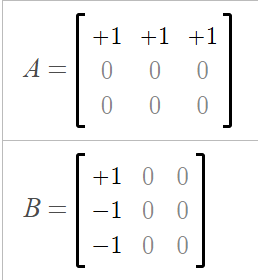
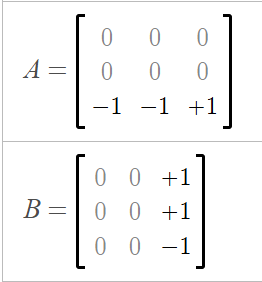
Alice and Bob win Alice and Bob lose
Because it is impossible to create a square such that each column multiplies to +1 and each row multiplies to -1, Alice and Bob can’t create a strategy that always wins – That is, unless Alice and Bob happen to own quantum labs with entangled states. If Alice and Bob determine what numbers to enter by performing some intelligent measurements on their entangled quantum system, they can create a strategy that lets them win no matter what! This “perfect strategy” takes advantage of two elements of quantum mechanics: Entanglement and quantum measurement. In quantum mechanics, measuring a state affects it. Entanglement is when two different labs share a state, but you cannot separate their shared state into their personal states. That means if Alice and Bob have an entangled state, Alice’s measurements can make it so Bob’s measurements will always agree in the overlapping square, which Alice would not be able to do otherwise.